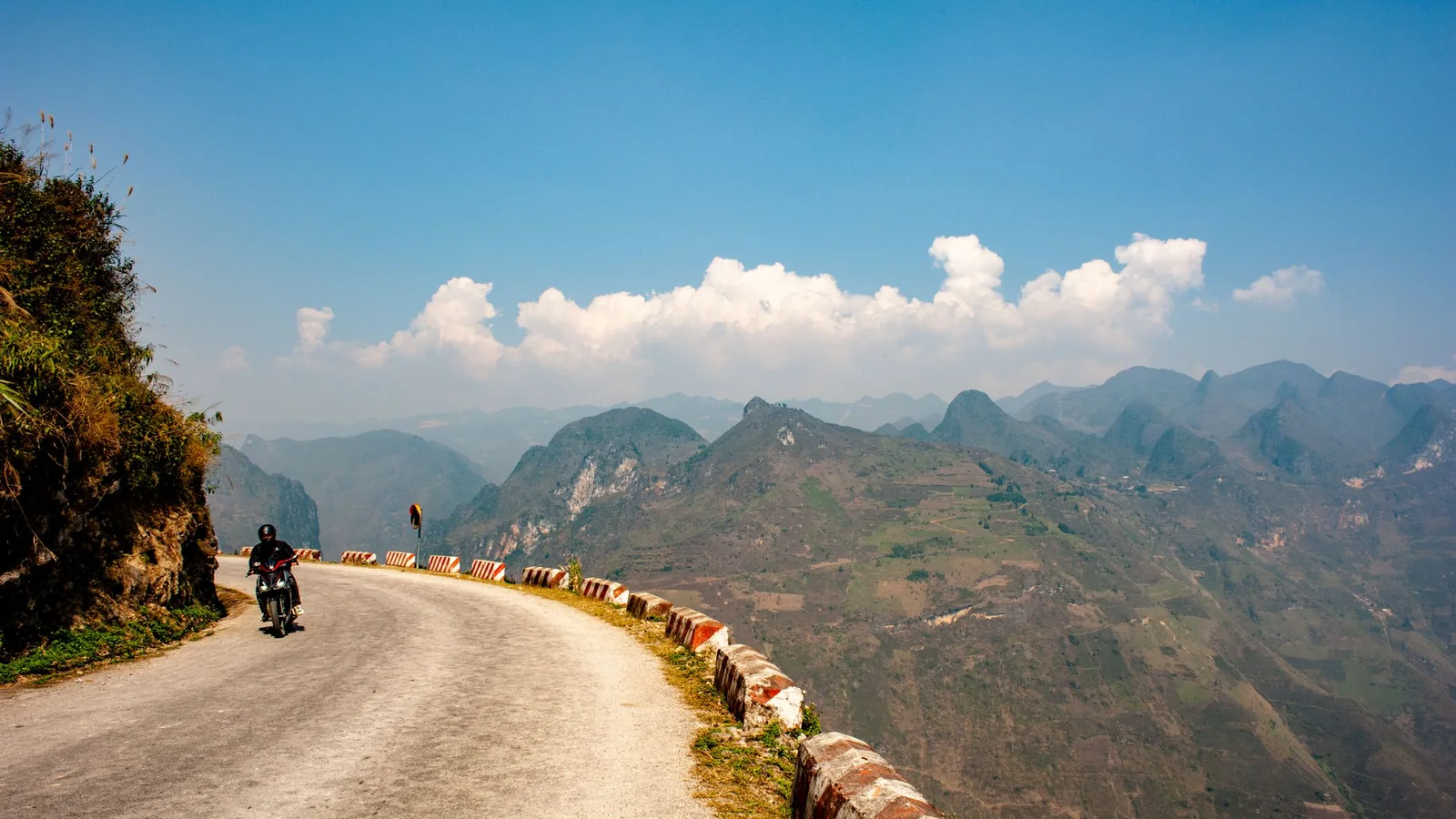
The Ha Giang Loop is a mountain road trip in northern Vietnam, not a single mountain to climb. Over several days you can see limestone peaks, village markets and the Nho Quế River far below winding passes. You can travel by your own motorcycle, sit behind a local motorcycle driver (often sold as an Easy Rider tour), or take a car with a driver. If you lack the correct motorcycle licence or strong mountain-riding experience, choose a driver rather than riding yourself. A rental shop handing you keys does not mean you can legally ride or that an insurer will cover an accident.
The appeal is as much the journey as the destination: a three- or four-day route can take in Quản Bạ’s mountain viewpoints, the limestone plateau around Đồng Văn and the dramatic Mã Pí Lèng Pass, with nights in small towns or homestays. The national tourism authority’s sample route shows the scenery and stopping places; it is not a promise that every road is open or every tour follows the same itinerary. Since Vietnam's 2025 provincial reorganisation, the former Hà Giang region is administratively part of Tuyên Quang province; a booking or weather alert may use either name. The national tourism authority describes the high mountain route and the government records the administrative merger. Neither is a promise that every road is open today.
Which way of travelling fits you?
| Your situation | Starting choice | The real trade-off |
|---|---|---|
| You already ride motorcycles on challenging mountain roads, have valid documents accepted in Vietnam for the exact bike and appropriate insurance | Self-ride, if today's road and weather conditions are suitable | Most freedom to stop, but you personally bear route, weather, vehicle and accident responsibilities |
| You want mountain views but are not legally or confidently able to ride yourself | Easy Rider: passenger on a local driver's motorbike | You do not operate the motorcycle; still exposed to road and weather risks, and must assess the driver's licence, helmet, bike and coverage |
| You have a child, mobility needs, large luggage or do not want a motorbike | Car/van with a driver | More room and weather protection, but road access, travel time and stopping places can differ from motorbikes |
| You only have one or two days and a fixed onward flight | Shorten the route or skip the Loop this time | Trying to cram narrow mountain roads into a fixed schedule makes delays or bad weather harder to manage |
A local driver is not a guarantee of safety. The national tourism authority itself suggests a local driver for unfamiliar steep roads. Even if friends describe their ride as easy, experience on flat city roads does not establish competence on narrow, foggy passes with sharp turns.
Two different trips
First-time visitor with only a car licence: You want the famous views and homestays but have never ridden a motorbike. Don't self-ride because an operator says “everyone does it.” Choose a reputable local-driver or car/van option that accepts your needs and confirms the itinerary, insurance and cancellation terms. Your enthusiasm for the scenery is not a licence category.
Experienced motorcyclist with an appropriate licence: A self-ride can offer flexibility, but check whether Vietnam recognises the exact national licence and international document you hold, whether their motorcycle categories match the bike's engine size and whether the insurance covers you on this specific trip. If any one answer is unclear, do not treat a rental receipt or a photograph of a permit as approval; use a driver.
What licence do foreigners need to self-ride?
Under Vietnam's Road Traffic Order and Safety Law No. 36/2024/QH15, effective 1 January 2025, driving entitlement depends on the vehicle category and a recognised licence. Article 57 sets domestic categories: A1 for motorcycles up to 125 cc and A for larger motorcycles (also covering A1 vehicles). Previous Vietnamese licences have specific transitional rules under Article 89, so do not assume an old Vietnamese A1 card always means the new 125 cc threshold. The law sets a usual 18-year minimum for A1/A licences under Article 59. Read the full government-published law.
For foreign licence recognition, Article 57(6–8) recognises, among other routes, an International Driving Permit (IDP) issued by a country party to the 1968 Vienna Convention together with the corresponding valid national driving licence, for the suitable vehicle category. The IDP and home licence must be carried together. There are also specific treaty-based bilateral recognition routes. An IDP is not a stand-alone licence, an English translation bought online does not create a valid permit, and a car-only endorsement does not authorise a motorcycle.
Important: Internet advice sometimes says “any international licence” or describes the 1949 Geneva Convention as sufficient. The published 2025 Vietnamese statute names the 1968 Vienna Convention; do not rely on an operator's outdated 1949 claim. Because licence origin, exact class, old/new transitional categories, bilateral arrangements and your status can differ, obtain confirmation from the competent traffic authority or a suitably qualified local adviser before agreeing to operate a motorcycle. Vietnam's Ministry of Public Security Circular 12/2025/TT-BCA also differentiates foreign national licence exchange from treaty-based international permits.
Insurance is a separate gate. Check the actual travel policy for motorcycling, passenger versus rider status, engine capacity, correct licence, helmet requirements, medical evacuation, exclusions and claims paperwork. Insurance sold by a rental operator may cover the vehicle or third-party liability without covering your hospital bills. No policy was reviewed here; coverage is NOT VERIFIED until the policy wording and insurer confirm it for you.
What should you inspect before booking a driver or tour?
For an Easy Rider tour, ask who actually drives you, rather than only the name of the online seller. For a car or van tour, ask who operates the vehicle and what type of roads it will use. Get clear answers to these questions before any non-refundable deposit:
- Driver and vehicle: the actual driver's valid licence for the bike/vehicle, passenger capacity, roadworthy brakes/tyres/lights, suitable helmet for you, and what happens if the driver or bike changes mid-trip.
- What the price includes: driver, motorcycle/vehicle, fuel, accommodation, meals, village or viewpoint admission fees, luggage transfer, single-room upgrades and any booking surcharge. A cheap headline may exclude the final transfer to Hanoi.
- Ride and group style: number of motorbikes, passenger-to-driver arrangements, maximum reasonable day length, whether stops are genuine or primarily shopping stops, whether you can request rest or decline an unsafe segment.
- Where you will sleep: exact homestay locations and room sharing, toilets, heating/blankets if relevant, and whether you can alter nights if weather closes a road.
- Cancellation and disruption: written refund/credit terms, route changes, a late arrival, medical incident or a landslide on the planned pass. Ask how the operator obtains local road-condition information and who will decide not to proceed.
- Passenger protection: the travel policy's coverage of riding as a passenger, operator coverage claims, emergency assistance and a practical arrangement to reach medical help from remote stretches.
A “licensed tour” description on social media does not prove that the individual driver, vehicle and insurance are compliant. Ask for documented details rather than accepting a promise of “100% safe.” If an operator dismisses a passenger helmet, insists on riding through dense fog or refuses to explain cancellation terms, walk away.
What makes the mountain route hard?
The official four-day itinerary follows the mountain passes around Yên Minh, Đồng Văn and Mã Pí Lèng, with steep bends and remote sections. Roads can encounter fog, heavy rain, stones, construction, uneven surfaces or landslides. Visibility, weather and local restrictions can change much faster than a generic best-season blog. A sunny morning photograph is not a road-status report.
Build a route around daylight riding and realistic stops; never promise a fixed number of hours merely because a map estimates a distance. Plan a credible fallback when a section closes, and avoid scheduling an unprotected international flight immediately after returning from the mountains.
If conditions deteriorate, stop somewhere safe and ask the actual local authority and operator about closures. Do not ask a driver to bypass barricades or use an unofficial cliffside detour for a photograph. Even on a guided tour, you can decline an unsafe segment.
How much should you budget?
Compare the complete cost for the same number of days and people, not a rental sticker against a fully hosted tour:
| Cost to compare | Self-riding | Easy Rider passenger | Driver and car/van |
|---|---|---|---|
| Vehicle / driver | Rental motorbike, fuel and any repair/deposit terms | Driver, motorbike and fuel—check the package | Vehicle, driver and fuel—check overtime and access |
| Nights and meals | Book and pay yourself | Often included, but verify each meal/room | May be separate or packaged |
| Luggage | Carry safely or pay a transfer | Check luggage-transport arrangements | Usually more space, but confirm |
| Entry fees and activities | Separate charges at some sights | Only included if expressly listed | Only included if expressly listed |
| Exposure to delay or cancellation | You manage rebooking and bike return | Operator's written policy controls | Operator's written policy controls |
No current fare is guaranteed here. Prices vary by date, group size, bike, private/shared rooms and inclusions. Request a written itemised quotation, plus the cancellation amount if weather prevents the intended route. A high price is not proof of safety; a cheap option can cost far more if it ignores proper licensing or medical cover.
Where do you start, and how do you get back?
Many trips start from the town still commonly called Hà Giang, with travellers arriving from Hanoi by a separately booked coach or transfer. Confirm its actual pickup and arrival point, whether the tour includes that journey, and the return transfer. Your booked itinerary should show meaningful stops, overnight locations and the actual return transfer—not just an attractive list of viewpoints. Compare Hanoi connections using the Vietnam transport guide.
Pack for changes in temperature and rain, carry usable cash for small local spending, and keep identity documents and an offline copy of your bookings. Near border areas, obey local signs and follow official directions on where visitors may go; a guide inviting you to a viewpoint does not override a restriction.
The booking decision: If the correct motorcycle entitlement, insurance, strong riding experience and acceptable road conditions are all confirmed, self-riding may fit. Otherwise choose an Easy Rider passenger tour or car/van with a responsible operator—and be ready to change the trip if the road is not suitable. The scenery will still be there on another day.